I was fortunate enough on Friday to get to see Los Tigres del Norte play in Richmond and, through the graciousness and generosity of Gilbert Reyes of Hohner accordions and the invaluable Reyes Forum , got to see it standing in the backstage area where I had an unimpeded view of the stage and great sound too. It was really a lot of fun. Like a fool I forgot my camera. The soundsystem was so insanely loud--as Norteño shows almost always are-- that standing on the side made it just overpowering rather than deafening. The music sounded good and the band was really tight. Los Tigres are such pros that they were really a marvel to watch them perform. I've seen them before a few years ago, but I was far off in the back of a large outdoor rodeo concert in Manassas. Standing just behind the sound man really gave me an appreciation for how tightly they ran the show, with roadies handing off instruments in highly choreographed maneuvers and virtually no break between songs for hours. Ed...
Posts

Between dealing with the aftermath of my accident, editing my book, spending a great week at the Tocqueville Institute at the University of Richmond , and preparing to go to Mongolia, Nunal has definitely suffered for attention. The days before I leave are going to be nuts as I go to Chicago to see my folks and help my dad split a beehive, to Madison for the SHAFR conference (and as an added bonus to see old good friends and play some music), and then to New Orleans for a rapidfire bender with a friend of mine turning 40 who runs bars there...all before leaving for Ulanbaatar in a week and a half. Somehow it is all going to happen I know, but it ain't going to be pretty. I'll leave you for the time being with this description of possible annoyances in Mongolia. It invites some interesting speculation. I also like the suggestion of how to recognize drunks: "Being out late at night is not advisable, especially if you are alone. Avoid ger districts and other poorly lit a...
saving the wild hives
This is a cool project: an attempt to map feral bee colonies by something called the Feral Bee Project . Feral bees have been surviving without intervention from people and so may indeed hold some critical secrets for survivability. "Feral" in this sense means not managed by a beekeeper. It does not mean they are any meaner or wilder. If you are wondering how to find one, there are some beelining tips on the page too. I definitely hold to the theory that the feral colonies hold the secret to the future of bee survival. It is one reason I like to get swarms as much as possible. Ialso have four of my hives that I have never done anything to and VERY rarely even inspect, maybe once or a few times a year. They have thrived, made honey, and requeened themselves year after year, six years running. No chemicals at all, no medications, nothing except some very occasional powdered sugar dusted on them. I use these strong hives as sources for nucs and propagate these queens si...
Diversions for the weekend
" Germans are stealing more beehives " sounds like it could be a headline from the Onion, but it is real. "Caught in the Act Over the past few years, the Apicultural State Institute at Hohenheim University in Stuttgart, which specializes in agricultural studies, has had 72 bee colonies stolen from various locations. And in Bavaria, a honey producer even stole queen bees from his own beekeeping collective. This spring the Apicultural State Institute set three camera traps -- shortly afterwards the cameras caught a 71-year-old, hobby beekeeper from Nürtingen in the state of Baden-Württemberg, in the act of bee abduction. To counter the increasing bee thievery, some apiarists have installed GPS devices in their hives so that they can track the colonies' whereabouts online, in case of theft. Others have taken to using honeycombs in unique sizes so that their bees cannot be so easily placed into other hives."
"to protect and serve"
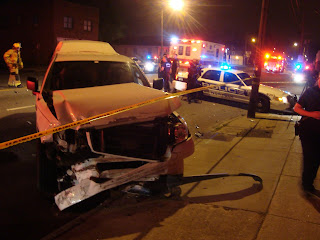
I spent the weekend working on my project on Mexicanization of social spaces in North Carolina, which was both enormously interesting and a lot of fun (more about it later in depth and with illustrations, when I can collect my thoughts). As I was driving back home I was lucky not to get killed when a fleeing thief slammed his car into my truck at high speed. He was being chased by the heroic Norfolk police following a break-in at a state ABC liquor store several miles away. Like most if not all high speed police chases, this one ended with a crash into some unlucky soul, which was me. I didn't really have time to react, it happened so quickly. As the car came out of a side street faster than I could do anything but think "what the fuck, this guy is coming so fast!!!" I found myself crashed on the other side of the street facing the wrong way with my front end smashed, air bag blown and my truck cab filled with smoke. I have no memory of the time between the impact an...
It goes without saying that it is difficult for historians to get published...and they have to endure an execrable job market...blah blah blah. But I must ask, how is it possible (or even a teeny bit just) for an utterly disgraced historian like Michael Bellesiles, who lost his tenured position, had his Bancroft Prize yanked ( Columbia found "After considering all of these materials, the Trustees concurred with the three distinguished scholars who reviewed the case for Emory University that Professor Bellesiles had violated basic norms of acceptable scholarly conduct"), and lost the profession's respect because his book was an invention and an insult to scholarship, not only secure another job (albeit an adjunct slot at some provincial Connecticut campus) but also get another book out ? While, it is pedantic to point out, the best minds of this generation are [destroyed by madness, starving hysterical naked] out there serving fries while endlessly being not published ...