"New Songdo will cost an estimated $30 billion to build, atop the $10 billion that the city of Incheon and the Korean government are spending on infrastructure projects. Every six months, $1 billion in construction is scheduled to begin. Morgan Stanley Real Estate is investing $350 million, and in November, Gale lined up $2.7 billion in financing led by Shinhan Bank....
The South Korean government has designated the area as a free economic zone, a bilingual city (Korean and English) where foreigners can own land and run schools and hospitals and where companies can get relief from Korean taxes and bureaucracy. It is also building a seven-mile bridge that will link New Songdo to Incheon International Airport, off the coast....
...Its 100-acre Central Park will be the centerpiece, with a seawater canal running through it, along with an art museum, an outdoor theater and a sculpture garden. At the park’s northern edge will be Park Avenue, a street of high-end residential buildings and hotels. Its Canal Street will be lined with shops and cafes.
A variety of architects from around the world have been commissioned to design various buildings, including a shopping center by Daniel Libeskind, a museum by the Swiss architect Peter Zumthor and a Jack Nicklaus golf course.
Some of the planners’ ideals ran up against Korean preferences, Mr. Gale and Mr. von Klemperer acknowledged. For example, Koreans typically favor large, multilane thoroughfares and large buildings on small plots of land, which don’t support a vibrant street life. A significant amount of debate among the Songdo team and Korean officials was required before the plans were completed.
Environmental considerations were also a priority. Water is recycled citywide, energy produced locally, and the Central Park is planted with low-maintenance native plants and trees, according to Mr. Gale. There will also be bicycle paths and pedestrian areas, and 40 percent of the city is reserved for parks and green space, he said."
Monday, December 31, 2007
The NYTimes has this interesting article about New Songdo City, being built on a landfill island off of Incheon. It sounds like it could really be something and is sidestepping the usual utilitarian flair-free modern Korean development. Or it could be a globalized island sized mall insta-city ideal for multinationals to use in sidestepping the constraints of full Korean sovereignty in pursuit of Mammon. Or something in between... Could extraterritorial rights for foreigners be far behind?

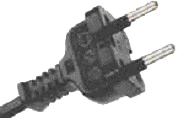
Korea uses 220 volt plugs. It isn't a big deal since nowadays many things like computers have little transponders or whatever they are that can be used with 110 or 220. It means that you just need a cheap little adaptor for most things to work.
The weird thing is that these plugs fall out of the wall with the slightest movement. If you touch one they sizzle and then fall out. The whole systems seems bizarrely cheap and maybe even dangerous (the sizzle is kind of freaky), especially considering that Korea is an electronics powerhouse. They should get this stuff, or so you would think.
(Now, there are some style of plugs that have big rubber gaskets that lock into the outlets, I will admit). But plugs still tend to fall out.
In America, surge protectors have become almost fetishistic if not actually pornographic. They are equivalent to Hummers. American crave crazily overbuilt things, it is a universal truth. The surge protectors, with all manner of technical ratings in joules emblazoned on them, are elaborate things with surge protectors for every conceivable style of plug, phone, dsl, USB line, you name it. The sockets are all stiff too, as if to afford a great sense of stability and vigor. The one I use at home is almost impossible to ge the plugs in and out of it. Here, I haven't seen actual surge protectors for sale anywhere at all, even expensive computers are plugged into the same cheapo powerstrips that are for sale on the street.
that old duststorm
and here I thought it was just kind of smoggy
INSIDE JoongAng Daily: "Besides the snow and cold, another unexpected and uninvited weather guest visited the country over the weekend.
A huge yellow dust storm formed in Seoul and the neighboring central provinces on Saturday, recording a level of 400 to 600 parts per million. It was the first time since 2001 that a yellow dust storm had reached the peninsula in December."
JeongMee Yoon's Blue & Pink Projects -- Daddy Types

Somebody linked to this in the comments on Nunal after my discussion of the complexities of the color pink over here. In case you missed it it is worth looking it:
JeongMee Yoon's Blue & Pink Projects -- Daddy Types
Somewhere along the way, South Korean photographer JeongMee Yoon noticed that her 8-year-old daughter refused to play with or wear anything that wasn't pink [ya think?!], and so she began the Pink Project and the Blue Project, in which little kids are photographed in the midst of all their gender-coded stuff. Pink and blue are equally overwhelming in both cultures where Yoon shot, the US and Korea.
The warm weather of most of last week turned very cold as the weekend approached. What better way to spend a grey, windy, cold day than to tour a former Japanese prison camp?
This is Seodaemun Prison, which is in our neighborhood although hard to get to easily for us because there is a mountain between us and it.
The prison is behind the Dongnimmun gate, the Independence Gate, and it is now currently imbedded in a large, heavily used park. Actually, it was heavily used back when I walked through here in August, when it was hot. Nobody was in it when we were there, they had too much sense. It was freezing and the wind was quite strong.
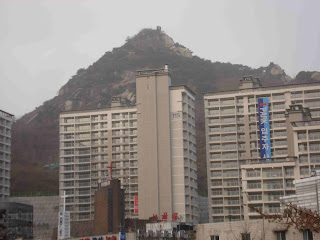
The mountains are quite steep right there. This is looking to the east across the street from the park. Note the two churches and how close everything is built to the mountain. And the typical Seoul apartment building style (which is to say: quasi-Soviet)

We have to go back some time because we intended to hike the mountains behind the prison where there are a number of shrines, but that plan was vetoed this time.
The prison complex is a bunch of brick buildings, quite foreboding as prisons are.


The two main buildings had absolutely huge Korean flags hanging on them:

It is a nationalist site to be sure. Which makes sense, since so many Korean patriots were imprisoned here by the Japanese, tortured, and in many cases killed too. The Independence movement was squashed brutally by the Japanese, and its leaders sent here.
Part of the point of this prison museum is so people learn how brutal the Japanese occupiers were. There is a strong message, and it gets reinforced as in this sign:

The cells are quite striking. I couldn't get a good picture of the interior of the cellblock because it was so dark, but it had an open walkway on the second floor. Here is an isolation cell:

and here is a regular one. The sign said it held "7.9 prisoners" which of course makes you wonder where the other 0.1 prisoners are.


Here is the execution area of the prison. Behind this wall is a small wooden building where the Japanese did their killing. Behind the wood building is a tunnel where the bodies were brought out.


So it is a somber place.
Until you get to the one building which is just flat bizarre if not actually insane.
Here you are supposed to be able to experience the torture. The "execution experience."

Part of it is to sit in a chair and stare through a hole in the walls, which have fake plaster collapse on them, much worse than even the cheesiest pizza parlor in the US.

While in the chair, you lean into the speakers, look at a mannequin and hear him (it?) screaming as it is tortured. I filmed it but it is so dark you can only hear the screaming.
The next room has a spot for you to stand in front of a mannequin panel of judges. The center mannequin judge, triggered by a photoelectric sensor, shakes his head as you are condemned to death. Somehow I neglected to capture this on film. But I did get a kick out of continually triggering the sensor. It was like a Disney ride.
The third room has perhaps the craziest tourist display I have ever seen. There is a panel of mannequin executioners and a hangman. In front is an unstable chair on a moving platform that the visitor is supposed to stand on. Above it is an actual noose.
I can't read the Korean, but the implication would be to feel the thrill of putting your head into the noose and wiggling around on the platform.

This execution experience is so out of keeping with the tone of the rest of the camp I would be fascinated to know when it was grafted on.
I wonder what the analog would be in the states? There are so many sites that could be desecrated this way, it is hard to choose. But it is wholly dissimilar from putting your head into the Pilgrim headstocks (a classic tourist picture) because of course those weren't patriots being tortured by a murderous, imperialist aggressor invader. Those were religious kooks killing infidels. But that is another story...
The prison does have a sign mentioning that the the execution experience (now with real noose!) might not be suitable for kids. "Children or Pregnant woman are not allowed to experien."

There was a group of three people in the execution experience at the same time as us but none of them hazarded a try at the experience. Surely though this is perfectly designed for the classic last line "hey, watch this!"
This is Seodaemun Prison, which is in our neighborhood although hard to get to easily for us because there is a mountain between us and it.
The prison is behind the Dongnimmun gate, the Independence Gate, and it is now currently imbedded in a large, heavily used park. Actually, it was heavily used back when I walked through here in August, when it was hot. Nobody was in it when we were there, they had too much sense. It was freezing and the wind was quite strong.
The mountains are quite steep right there. This is looking to the east across the street from the park. Note the two churches and how close everything is built to the mountain. And the typical Seoul apartment building style (which is to say: quasi-Soviet)

We have to go back some time because we intended to hike the mountains behind the prison where there are a number of shrines, but that plan was vetoed this time.
The prison complex is a bunch of brick buildings, quite foreboding as prisons are.


The two main buildings had absolutely huge Korean flags hanging on them:

It is a nationalist site to be sure. Which makes sense, since so many Korean patriots were imprisoned here by the Japanese, tortured, and in many cases killed too. The Independence movement was squashed brutally by the Japanese, and its leaders sent here.
Part of the point of this prison museum is so people learn how brutal the Japanese occupiers were. There is a strong message, and it gets reinforced as in this sign:

The cells are quite striking. I couldn't get a good picture of the interior of the cellblock because it was so dark, but it had an open walkway on the second floor. Here is an isolation cell:

and here is a regular one. The sign said it held "7.9 prisoners" which of course makes you wonder where the other 0.1 prisoners are.


Here is the execution area of the prison. Behind this wall is a small wooden building where the Japanese did their killing. Behind the wood building is a tunnel where the bodies were brought out.


So it is a somber place.
Until you get to the one building which is just flat bizarre if not actually insane.
Here you are supposed to be able to experience the torture. The "execution experience."

Part of it is to sit in a chair and stare through a hole in the walls, which have fake plaster collapse on them, much worse than even the cheesiest pizza parlor in the US.

While in the chair, you lean into the speakers, look at a mannequin and hear him (it?) screaming as it is tortured. I filmed it but it is so dark you can only hear the screaming.
The next room has a spot for you to stand in front of a mannequin panel of judges. The center mannequin judge, triggered by a photoelectric sensor, shakes his head as you are condemned to death. Somehow I neglected to capture this on film. But I did get a kick out of continually triggering the sensor. It was like a Disney ride.
The third room has perhaps the craziest tourist display I have ever seen. There is a panel of mannequin executioners and a hangman. In front is an unstable chair on a moving platform that the visitor is supposed to stand on. Above it is an actual noose.
I can't read the Korean, but the implication would be to feel the thrill of putting your head into the noose and wiggling around on the platform.

This execution experience is so out of keeping with the tone of the rest of the camp I would be fascinated to know when it was grafted on.
I wonder what the analog would be in the states? There are so many sites that could be desecrated this way, it is hard to choose. But it is wholly dissimilar from putting your head into the Pilgrim headstocks (a classic tourist picture) because of course those weren't patriots being tortured by a murderous, imperialist aggressor invader. Those were religious kooks killing infidels. But that is another story...
The prison does have a sign mentioning that the the execution experience (now with real noose!) might not be suitable for kids. "Children or Pregnant woman are not allowed to experien."

There was a group of three people in the execution experience at the same time as us but none of them hazarded a try at the experience. Surely though this is perfectly designed for the classic last line "hey, watch this!"
Saturday, December 29, 2007
Here are a few things that amused me.
The Merry Crristmas/Happy New Year sign with large Jewish star.

and then this sign I saw on a car today was interesting.

This is self explanatory. Though I haven't tried this restaurant, it is something I try to do everyday.
The Merry Crristmas/Happy New Year sign with large Jewish star.

and then this sign I saw on a car today was interesting.

This is self explanatory. Though I haven't tried this restaurant, it is something I try to do everyday.
Wednesday, December 26, 2007
I may have to fly to Asia every year at Christmas time. It is definitely the place to escape the holiday.
As I have written here, it seemed to me that Christmas had permeated everything because of lights, signs, nutcrackers, carols, and even gas station attendents wearing Santa hats. Turns out that all amounted to a whole lot of nothing. Thankfully.
Christmas here seems just to have been appropriated exclusively for commercial purposes. The iconography is there, but only I think to trigger (or perhaps to create) a Pavlovian consumerist response. Almost everything was open on Christmas, fruit sellers, auto repair shops, dry cleaners, liquor stores, supermarkets, coffee shops, restaurants. All of the important things in life. Plus it was a warm day, perfect day to be outside.
Usually on Christmas I like to go to the movies. But the only think I wanted to see was the post-apocalyptic film I am Legend, and hell, I bought that on DVD form a street vendor before it was even in the theares. Nice letterboxed version too. I did have to pay 3000 Won though (3 bucks), kind of pricey for a street DVD, but it did save the day for being outside...
What better thing to do on Christmas than visit a Buddhist temple? So we went to spend the day wondering around a temple complex on the south side of the river. It is a beautiful temple on a wooded hillside that is totally surrounded by huge, glass encased skyscrapers. The COEX mall and convention center are done there, it is a very busy and slick area.
Here is a view

I'm not much of a landscape photographer, but you get the idea.
We did happen on the Bob Dylan bar, which is on the corner of this big building.


So you walk through all of this to get to the temple, which is nestled in between. Once you are in, however, it is very quiet and peaceful.
Here is the front gate.

Here are some lanterns hanging outside the main temple building, which has three gold Buddhas. These are quite a big smaller than the Buddhas at Jogyesa.

There was something about the combination of the silence of the temple, the colorful lanterns, the grey sky, and the tall buildings in the distance that made the whole experience very serene. Pictures don't remotely capture the feeling.


A central feature of this temple is the huge concrete Buddha on top of the hill. Not quite as striking as thr one in Songnisan since it is not gold, but still extremely impressive.

In front was a large marble area where people removed their shoes and knelt in prayer. To either side are little huts where there are pillows to sit on. By the evening (these pictures wer taken around 5 or so) it was chilly, and walking on the cold marble with no shoes must have been quite cold. Some people were there for some time.

Overall, a good way to pass a Christmas day.
As I have written here, it seemed to me that Christmas had permeated everything because of lights, signs, nutcrackers, carols, and even gas station attendents wearing Santa hats. Turns out that all amounted to a whole lot of nothing. Thankfully.
Christmas here seems just to have been appropriated exclusively for commercial purposes. The iconography is there, but only I think to trigger (or perhaps to create) a Pavlovian consumerist response. Almost everything was open on Christmas, fruit sellers, auto repair shops, dry cleaners, liquor stores, supermarkets, coffee shops, restaurants. All of the important things in life. Plus it was a warm day, perfect day to be outside.
Usually on Christmas I like to go to the movies. But the only think I wanted to see was the post-apocalyptic film I am Legend, and hell, I bought that on DVD form a street vendor before it was even in the theares. Nice letterboxed version too. I did have to pay 3000 Won though (3 bucks), kind of pricey for a street DVD, but it did save the day for being outside...
What better thing to do on Christmas than visit a Buddhist temple? So we went to spend the day wondering around a temple complex on the south side of the river. It is a beautiful temple on a wooded hillside that is totally surrounded by huge, glass encased skyscrapers. The COEX mall and convention center are done there, it is a very busy and slick area.
Here is a view

I'm not much of a landscape photographer, but you get the idea.
We did happen on the Bob Dylan bar, which is on the corner of this big building.


So you walk through all of this to get to the temple, which is nestled in between. Once you are in, however, it is very quiet and peaceful.
Here is the front gate.

Here are some lanterns hanging outside the main temple building, which has three gold Buddhas. These are quite a big smaller than the Buddhas at Jogyesa.

There was something about the combination of the silence of the temple, the colorful lanterns, the grey sky, and the tall buildings in the distance that made the whole experience very serene. Pictures don't remotely capture the feeling.


A central feature of this temple is the huge concrete Buddha on top of the hill. Not quite as striking as thr one in Songnisan since it is not gold, but still extremely impressive.

In front was a large marble area where people removed their shoes and knelt in prayer. To either side are little huts where there are pillows to sit on. By the evening (these pictures wer taken around 5 or so) it was chilly, and walking on the cold marble with no shoes must have been quite cold. Some people were there for some time.

Overall, a good way to pass a Christmas day.
Monday, December 24, 2007
the ongoing eyeball
Here are a bunch of scenes from the past few days.
With the semester done, and the weather warm, we have been exploring various corners of the city we haven't been.
We spent an afternoon walking around Yeohuido island, which is often compared to Manhattan by people here since it is the central financial center of Seoul. It is also a government center since the National Assembly is there. The architecture on the island is different from the rest of Seoul, more modern in most cases and western looking.

We have to be careful to pronounce our neighborhood carefully (Yeonhui-dong) or a cab will bring us to Yeohuido. The "n" is crucial if you want to get home.
Yeohuido also has the tallest building in Seoul, which is called the 63 Building. It is, yes, 63 stories tall. I have heard that it was limited to that height because of something related to the military academy, but I can't remember the exact story.

It is a very striking building, especially considering how much it dominates the others around it.
Apparently Busan is going to have a 106 story building in the next decade, so this will be eclipsed.
What amazed me is this team of window washers. They were washing each floor for 12 seconds by hand, wiping in a circular motion with both hands as they were hoisted up. No squeezge or motorized apparatus. That looked exhausting.

The island is ringed by parks along the Han River and it features a large park in the middle with a grassy middle and wooded areas on either end. The wooded areas are rather fancifully called "wilderness areas," but they are pleasant little green spaces at least. It is a nice place to stroll.
I gather that the park didn't even exist until 1999, it used to all be paved. (In keeping with my theory that Seoul is on a move toward beautification that is going to pay big dividends in the future).
Nice big statue of King Sejong in the park.

The center of the park still has a large Soviet- sized paved plaza with an enormous Korean flag. It is relatively uncommon to see the Korean flag (I have only seen two others near this size, in the DMZ and in a park in Geoyonggi Province).

Only certain things are allowed in the park.
No coughing.

though married boxing couples are welcome.

In another trip we got on a bus and took it in a direction we had never been. We were really happy to find that it took us to a Buddhist temple complex that is not in any of our guidebooks. It is Bongguk-sa and it was built in 1395.
The temple is built into a beautiful steep wooded hillside. It rises very steeply from the busy street and offers a really welcome respite from the traffic and pollution of Seoul.
Looking from the hill back to the front gate, here is a view giving you an idea of how in the middle of the city it is. Note Naebu expressway, which is the one that runs down by our apartment that we go jogging under.

There is another gate with a large Buddhist bell.

The complex features several buildings, colorfully painted and quite beautiful. Some of them are built right next to the rock faces.


Here are some kimchi jars at the temple.

At the highest point, up a curving stone stiarcase in the hillside, there are little crevices with small statutes and necklaces.

We got back on the bus and ended up way on the other side of Seoul in an are filled with hundreds of traditional herb shops. It was very interesting, these shops filled with bark, roots, herbs, and god-knows-what-all.

We had fun randomly taking a bus in a new direction, though this adventure took us about an hour and half away from our house once we figured out where we were, giving you some idea of the size of Seoul.
A few other things caught my eye as we wandered about.
I don't know what this machine does, but it looked like something out of the movie "Brazil".

The name of this joint maybe could use some work.

One area of butcher shops we wandered in specialized only in selling beef ribcages and pig spines (with tail still attached).

Here are two views of two rappelling Santas on a building on our street, a night view of one and a day view of the other. I have to explore whether Santa rappells all over Korea or only here. The two together look like a Santa assault.


Here is a generic view of lots of red peppers, a core food here of course.

and slightly more interesting view of a garlic truck with garlic for sale on the street.

And a shot of a pig's head on a bowl of intestines. One of the Fulbrights, who has been in Korea several times for extended times over the past 20 years, saw this picture and said "oh, the obligatory pigface picture."
So, here is the obligatory pigface picture.

Squid swimming in a tank, which are fascinating to watch swim. (almost more fun than eating them)

and, finally, a Korean homie in full regalia.
With the semester done, and the weather warm, we have been exploring various corners of the city we haven't been.
We spent an afternoon walking around Yeohuido island, which is often compared to Manhattan by people here since it is the central financial center of Seoul. It is also a government center since the National Assembly is there. The architecture on the island is different from the rest of Seoul, more modern in most cases and western looking.

We have to be careful to pronounce our neighborhood carefully (Yeonhui-dong) or a cab will bring us to Yeohuido. The "n" is crucial if you want to get home.
Yeohuido also has the tallest building in Seoul, which is called the 63 Building. It is, yes, 63 stories tall. I have heard that it was limited to that height because of something related to the military academy, but I can't remember the exact story.

It is a very striking building, especially considering how much it dominates the others around it.
Apparently Busan is going to have a 106 story building in the next decade, so this will be eclipsed.
What amazed me is this team of window washers. They were washing each floor for 12 seconds by hand, wiping in a circular motion with both hands as they were hoisted up. No squeezge or motorized apparatus. That looked exhausting.

The island is ringed by parks along the Han River and it features a large park in the middle with a grassy middle and wooded areas on either end. The wooded areas are rather fancifully called "wilderness areas," but they are pleasant little green spaces at least. It is a nice place to stroll.
I gather that the park didn't even exist until 1999, it used to all be paved. (In keeping with my theory that Seoul is on a move toward beautification that is going to pay big dividends in the future).
Nice big statue of King Sejong in the park.

The center of the park still has a large Soviet- sized paved plaza with an enormous Korean flag. It is relatively uncommon to see the Korean flag (I have only seen two others near this size, in the DMZ and in a park in Geoyonggi Province).

Only certain things are allowed in the park.
No coughing.

though married boxing couples are welcome.

In another trip we got on a bus and took it in a direction we had never been. We were really happy to find that it took us to a Buddhist temple complex that is not in any of our guidebooks. It is Bongguk-sa and it was built in 1395.
The temple is built into a beautiful steep wooded hillside. It rises very steeply from the busy street and offers a really welcome respite from the traffic and pollution of Seoul.
Looking from the hill back to the front gate, here is a view giving you an idea of how in the middle of the city it is. Note Naebu expressway, which is the one that runs down by our apartment that we go jogging under.

There is another gate with a large Buddhist bell.

The complex features several buildings, colorfully painted and quite beautiful. Some of them are built right next to the rock faces.


Here are some kimchi jars at the temple.

At the highest point, up a curving stone stiarcase in the hillside, there are little crevices with small statutes and necklaces.

We got back on the bus and ended up way on the other side of Seoul in an are filled with hundreds of traditional herb shops. It was very interesting, these shops filled with bark, roots, herbs, and god-knows-what-all.

We had fun randomly taking a bus in a new direction, though this adventure took us about an hour and half away from our house once we figured out where we were, giving you some idea of the size of Seoul.
A few other things caught my eye as we wandered about.
I don't know what this machine does, but it looked like something out of the movie "Brazil".

The name of this joint maybe could use some work.

One area of butcher shops we wandered in specialized only in selling beef ribcages and pig spines (with tail still attached).

Here are two views of two rappelling Santas on a building on our street, a night view of one and a day view of the other. I have to explore whether Santa rappells all over Korea or only here. The two together look like a Santa assault.


Here is a generic view of lots of red peppers, a core food here of course.

and slightly more interesting view of a garlic truck with garlic for sale on the street.

And a shot of a pig's head on a bowl of intestines. One of the Fulbrights, who has been in Korea several times for extended times over the past 20 years, saw this picture and said "oh, the obligatory pigface picture."
So, here is the obligatory pigface picture.

Squid swimming in a tank, which are fascinating to watch swim. (almost more fun than eating them)

and, finally, a Korean homie in full regalia.
Friday, December 21, 2007
Here is a restaurant regulation you don't hear much in the U.S.
INSIDE JoongAng Daily: "In addition, the ministry has new regulations that will shut down any business that sells food if it is found to have conducted business related to the sex industry."
Though I have been asked my opinion of the presidential election here by several people, I have to admit that I have little in the way of novel insight about the change in Korea's political trajectory.
I am hoping to get some better ideas from the Fulbrights who are actually experts in this field when I see them this weekend.
Clearly, though, relations with the U.S. at the official level in terms of strategic security policy will remain strong and interdependent (or co-dependent?).
and there may be some mitigation of the two Koreas' integration push (and Lee has made that clear), though my feeling is that if the economy stays strong than the ROK's development penetration of the North is really rewriting things on the ground in important ways.
But I have been woefully wrong before.
The real story to watch I think is that economic ties will almost certainly be deepened by the likely passage of the free trade agreement (FTA), which is one of the biggest issues at the moment, of course, and of which Lee is extremely supportive.
As the Korea Times reported today:
The biggest issues are agricultural. Korean farmers, wise as they are, have this sneaking suspicion that free trade will be an economic tsunami for them.
That drive to cheapness via free trade can have its flipside, no? Just ask American textiles workers, steel workers, or any industrial worker. They are easy to find, they are working over at the Wal-mart peddling Chinese made goods.
It is not unusual that Korean agricultural interests are wondering what Free Trade with the U.S. might actually look like. Adam Smith it is not.
Less regulation and open markets for enormously subsidized American farmers and beef producers-- that is a recipe that perhaps we should let the Mexicans teach Koreans.
It sounds completely counter-intutive that Mexicans can't raise corn cheaper locally than massive American agribusiness can import it, but it is so. NAFTA has about devastated farmers in Mexico since U.S. corn has been progressively let into their market (and, unintendedly, led many of them to move North).
And the real test is going to start in a couple of weeks on Jan. 1 when full blown free trade in corn is instituted:
Now, I don't know if this just a coincidence, but the very same day that Lee is elected, the "most viewed photo" announced on the Korea Times' website is this one of Mexican clowns celebrating the Virgin of Guadalupe at the Basilica of Guadalupe.
I leave it to you to determine the significance of this, if any.
I am hoping to get some better ideas from the Fulbrights who are actually experts in this field when I see them this weekend.
Clearly, though, relations with the U.S. at the official level in terms of strategic security policy will remain strong and interdependent (or co-dependent?).
Lee is a critic of the Roh administration's policy toward the United States.
He has repeatedly said: ``The incumbent government has tried to change the pillar of the Korea-U.S. alliance without any blueprint and thereby weakened relations between the two allies.''
``Restoring the Korea-U.S. alliance based on the established friendship'' is also among the seven goals of the MB doctrine.
and there may be some mitigation of the two Koreas' integration push (and Lee has made that clear), though my feeling is that if the economy stays strong than the ROK's development penetration of the North is really rewriting things on the ground in important ways.
But I have been woefully wrong before.
The real story to watch I think is that economic ties will almost certainly be deepened by the likely passage of the free trade agreement (FTA), which is one of the biggest issues at the moment, of course, and of which Lee is extremely supportive.
As the Korea Times reported today:
It's not only the Korean citizens eagerly awaiting President-elect Lee Myung-bak ― the ``bulldozer'' known to turn the impossible into possible ― to restore the country's economic glory.
Foreign businesses here that may have been silently rooting for the former Hyundai CEO for his investment-friendly campaign pledges have been quick to welcome his landslide victory Wednesday, many calling attention to their own agendas.
The lingering beef issue stalling the ratification of the South Korea-U.S. free trade agreement (FTA) topped the order of business for the U.S. lobbying group, the American Chamber of Commerce in Korea (AMCHAM).
The biggest issues are agricultural. Korean farmers, wise as they are, have this sneaking suspicion that free trade will be an economic tsunami for them.
Many experts forecast that Lee, a strong advocate of FTAs, will sign off on existing, incomplete deals and go after many more.
And the beef issue dogging the KORUS deal is expected to find a fresh solution, as the former Seoul mayor said earlier this year, ``People are perhaps overly sensitive about bone-in beef, but they should also look at the flipside of being able to enjoy cheaper meat, too.''
He added that the stereotypical mindset that ``FTAs will kill farmers'' should be dismissed.
Just one day after the election, the conservative winner renewed his promise to boost business sentiment for foreign investors through deregulation.
That drive to cheapness via free trade can have its flipside, no? Just ask American textiles workers, steel workers, or any industrial worker. They are easy to find, they are working over at the Wal-mart peddling Chinese made goods.
It is not unusual that Korean agricultural interests are wondering what Free Trade with the U.S. might actually look like. Adam Smith it is not.
Less regulation and open markets for enormously subsidized American farmers and beef producers-- that is a recipe that perhaps we should let the Mexicans teach Koreans.
It sounds completely counter-intutive that Mexicans can't raise corn cheaper locally than massive American agribusiness can import it, but it is so. NAFTA has about devastated farmers in Mexico since U.S. corn has been progressively let into their market (and, unintendedly, led many of them to move North).
And the real test is going to start in a couple of weeks on Jan. 1 when full blown free trade in corn is instituted:
SAN SALVADOR EL SECO, Mexico (Reuters) - Cheap U.S. corn will flood into Mexico in January when trade barriers are lifted, pitting local farmers against each other over how to protect the crop that has fed Mexico for thousands of years.
Mexico is to scrap import duties of U.S. corn on January 1, under the North American Free Trade Agreement, or NAFTA, in a move that will allow the world's No. 1 producer to expand its market in the country that claims to have discovered corn.
Mexican growers are debating whether to turn to genetically modified strains of corn to resist the U.S. challenge, or to mechanize production but keep local corn strains GMO-free.
Either way, millions of Mexican farmers, many of them living just above subsistence, will struggle to compete with heavily subsidized U.S. corn despite high international corn prices.
"All the inequalities leave us unprepared for the opening," said Carlos Salazar the head of a national corn growers' association who works with farmers in the eastern town of San Salvador El Seco, where flat fields of corn and cactus stretch for miles below three snow-capped volcanoes.
Corn tariffs have gradually been phased out since the trade deal was implemented in 1994, and imports of yellow corn from the United States to Mexico have skyrocketed by about 240 percent compared to the decade before NAFTA. Mexico imported over 7 million metric tons of U.S. yellow corn in 2006.
Imported yellow corn, mostly used for animal feed, now accounts for close to 35 percent of local consumption and is likely to increase next year.
The biggest worry for Mexican farmers is that zero barriers could give U.S. producers incentives to grow more white corn, Mexico's principal crop, which is used to make tortillas and other famed foods.
Now, I don't know if this just a coincidence, but the very same day that Lee is elected, the "most viewed photo" announced on the Korea Times' website is this one of Mexican clowns celebrating the Virgin of Guadalupe at the Basilica of Guadalupe.
I leave it to you to determine the significance of this, if any.
Wednesday, December 19, 2007
Lee Set for Victory in South Korea - New York Times
The NYTimes updates its page much more often than the Korean newspaper English sites.
We had dinner in a sashimi place and people watched the TV but nobody made a peep. The election results did not interfere with the hearty soju drinking going on at every filled table. For some reason not made clear to us, representatives from a soju company, wearing silver lame' suits with flat panel screens in the front -- which was extremely weird and futuristic and I am kicking myself for not taking a picture-- were actually giving out free soju bottles to each table. The election was given less attention as a result.
Lee Set for Victory in South Korea - New York Times: "With giant screens flashing the exit poll results, downtown Seoul reverberated with cheers. Fireworks soared into the chill winter sky. Thousands of Mr. Lee’s supporters danced and hugged each other. Television footage showed villagers at Mr. Lee’s rural hometown of Pohang in southeast South Korea dancing and waving national flags."
We had dinner in a sashimi place and people watched the TV but nobody made a peep. The election results did not interfere with the hearty soju drinking going on at every filled table. For some reason not made clear to us, representatives from a soju company, wearing silver lame' suits with flat panel screens in the front -- which was extremely weird and futuristic and I am kicking myself for not taking a picture-- were actually giving out free soju bottles to each table. The election was given less attention as a result.
various Seoul scenes today
Today was election day, which is an official holiday here. Government, schools, post offices, and banks are closed, but everything else was of course booming. Not a bad day to check out the city when people are afoot.
There is an ice rink set into the large green in front of City Hall. I was surprised to see the kids all wearing helmets. Note the big bin of helmets in front.

It all seemed very safe and thus very American to wear a helmet. But do kids in the US do this? I don't know. I was surprised to see it here of course because bicyclists don't wear helmets and because kids don't sit in car seats. Most of the ones I have seen are in the front seat, on their parent's lap. Easier that way to get through the windshield, I guess.
When it got dark downtown there is quite an elaborate Christmas light display going on along Cheonggye Stream for several blocks. Christmas is really impossible to escape in the center of Central Seoul (though it is bustling life as usual in the rest of the central part).

There were mobs of people, on the street and below street level at the stream, lots of TV cameras too. A touristy thing to do, no doubt, but somehow we ended up on the end of it and were compelled to walk through. Surprisingly, there were zero noticeable police, no barricades, and the whole thing was very orderly.
The light displays were corporate sponsored, so they featured corporate logos. One was sponsored by the city of Seoul. The thing I find most interesting is that the logo and the slogan are in English. This is a ubiquitous logo, it is on cabs and other places all over the city.

So many signs in the city are in English, it is fascinating. Even the subway/bus electronic cards are called "T Money Cards". Some very common places, such as convenience stores like Family Mart, only have their names in English. It is an interesting phenomenon. I will be interested to see if this is the case in Busan, where we will be traveling shortly.
As usual, Lark was a big hit and several people asked to pose in pictures with her. What they will do with this picture I can't imagine. Maybe sell it when she is President.
One cool thing were these impressively large touchscreens featuring different images of parts of Seoul.

Santa was down the street. Santa is evidently a gringo over here too.

Lark was a bit underwhelmed at her first sighting of Santa in the plastic flesh.

More interesting than the Christmas lights was this upended cow over in Jongno.

Here is a semi-permanent homeless encampment in a subway station. Note the guy's head in his home.

Here is a view from the other side, one of them had a little blanket as door.

You don't see too many homeless here like you would in DC or New York, but there are some to be sure. What you definitely do not see are belligerent, drunk, or insane homeless people, which are often the norm in the US (or all three at once).
Here was a rather arresting image I saw on a magazine for sale next to Sogang. The title is in English but the rest if Korean, so I don't know what the story is about.
There is an ice rink set into the large green in front of City Hall. I was surprised to see the kids all wearing helmets. Note the big bin of helmets in front.

It all seemed very safe and thus very American to wear a helmet. But do kids in the US do this? I don't know. I was surprised to see it here of course because bicyclists don't wear helmets and because kids don't sit in car seats. Most of the ones I have seen are in the front seat, on their parent's lap. Easier that way to get through the windshield, I guess.
When it got dark downtown there is quite an elaborate Christmas light display going on along Cheonggye Stream for several blocks. Christmas is really impossible to escape in the center of Central Seoul (though it is bustling life as usual in the rest of the central part).

There were mobs of people, on the street and below street level at the stream, lots of TV cameras too. A touristy thing to do, no doubt, but somehow we ended up on the end of it and were compelled to walk through. Surprisingly, there were zero noticeable police, no barricades, and the whole thing was very orderly.
The light displays were corporate sponsored, so they featured corporate logos. One was sponsored by the city of Seoul. The thing I find most interesting is that the logo and the slogan are in English. This is a ubiquitous logo, it is on cabs and other places all over the city.

So many signs in the city are in English, it is fascinating. Even the subway/bus electronic cards are called "T Money Cards". Some very common places, such as convenience stores like Family Mart, only have their names in English. It is an interesting phenomenon. I will be interested to see if this is the case in Busan, where we will be traveling shortly.
As usual, Lark was a big hit and several people asked to pose in pictures with her. What they will do with this picture I can't imagine. Maybe sell it when she is President.
One cool thing were these impressively large touchscreens featuring different images of parts of Seoul.

Santa was down the street. Santa is evidently a gringo over here too.

Lark was a bit underwhelmed at her first sighting of Santa in the plastic flesh.

More interesting than the Christmas lights was this upended cow over in Jongno.

Here is a semi-permanent homeless encampment in a subway station. Note the guy's head in his home.

Here is a view from the other side, one of them had a little blanket as door.

You don't see too many homeless here like you would in DC or New York, but there are some to be sure. What you definitely do not see are belligerent, drunk, or insane homeless people, which are often the norm in the US (or all three at once).
Here was a rather arresting image I saw on a magazine for sale next to Sogang. The title is in English but the rest if Korean, so I don't know what the story is about.
Tuesday, December 18, 2007
This evening we went over to the opening of an exhibit called "Transpop: Korea Vietnam Remix," which is a collection of art dealing with Korean and Vietnamese identity, particularly after the Vietnam War. The description of the exhibit is interesting:L
You can read more here at the exhibit website.
It is curated by Viet Le and also by Yong Soon Min, who is from UC-Irvine and was part of that Seoul National University conference on migration last month where I presented on Mexican migrant music. It was interesting to have had a chance to hear her give a paper on Korean-American art (about which I knew nothing) and to see her work as a curator in this setting.
The exhibit was out at the Arko Art Center, where neither of us have been before, so that was a good excuse to get out there too.
"The interactions between Vietnam and Korea span centuries but the exhibition's focus lies in their shared history of a highly accelerated modernization process. During the American War in Vietnam, the Republic of Korea was the second largest foreign military and economic presence in Vietnam behind the United States. The financial boon from the involvement in the war played a catalytic role in the economic development of Korea. The legacy of the Cold Wars is evident in the large Korean and Vietnamese diasporic communities in the U.S.A. In Vietnam, this accelerated modernity is evident in the breakneck speed of current economic development, as well as its entry into the World Trade Organization."
You can read more here at the exhibit website.
It is curated by Viet Le and also by Yong Soon Min, who is from UC-Irvine and was part of that Seoul National University conference on migration last month where I presented on Mexican migrant music. It was interesting to have had a chance to hear her give a paper on Korean-American art (about which I knew nothing) and to see her work as a curator in this setting.
The exhibit was out at the Arko Art Center, where neither of us have been before, so that was a good excuse to get out there too.
We are always asked, as we tool around Seoul in service to the Lil Buddha, if she is a boy or a girl. This is a fine question, since of course the gender of babies is hard to tell. The fact that she is the cutest little girl baby is not readily apparent beneath all of the layers, alas.
But the reason that it strikes me is that Lark is so often dressed in pink. Pink is the universal sign of "I am a girl baby although you can't possibly tell the difference." Or so I thought.
Now, I must state for the record, I despise pink. I had hoped that just because she is a girl she could be free of society's construct of the feminine baby, which is centered on the color pink. Nevertheless, given the very much appreciated, big money-saving gifts of innumerable family and friends, Lark has piles of pink everything--hats, jackets, shoes, onesies, all of that stuff. We are talking seriously pink

People ask if this pink Nanook is a girl or a boy.
The reason is of course is that pink is entirely another color over here. It is free of any gender coloration I guess. There is no hesitation to wear it. Men where pink shirts and pink ties very commonly, something you don't see in the U.S. outside of the Preppie Handbook.
It hasn't quite reached the level of the current Thai craze for pink shirts, selling at the rate of 40,000 a month because the King sported one, but it is interesting to behold.
But the reason that it strikes me is that Lark is so often dressed in pink. Pink is the universal sign of "I am a girl baby although you can't possibly tell the difference." Or so I thought.
Now, I must state for the record, I despise pink. I had hoped that just because she is a girl she could be free of society's construct of the feminine baby, which is centered on the color pink. Nevertheless, given the very much appreciated, big money-saving gifts of innumerable family and friends, Lark has piles of pink everything--hats, jackets, shoes, onesies, all of that stuff. We are talking seriously pink

People ask if this pink Nanook is a girl or a boy.
The reason is of course is that pink is entirely another color over here. It is free of any gender coloration I guess. There is no hesitation to wear it. Men where pink shirts and pink ties very commonly, something you don't see in the U.S. outside of the Preppie Handbook.
It hasn't quite reached the level of the current Thai craze for pink shirts, selling at the rate of 40,000 a month because the King sported one, but it is interesting to behold.
Apparently, as a student told me today as she turned in her final, some of the students here have nicknamed me "Dracula."
Not because I suck blood (I asked) or because I am inherently nocturnal (true but apparently unknown and irrelevant) but even more strangely because, as my student said, "you are white" and because "you know so much about history."
That last one got me until the student explained that vampires know a lot about history because they are eternal...or something like that. I guess logic is not the key here.
The real issue is that the nickname they gave me is "Dracula," which is not a very cool nickname. What about Nosferatu?

Makes me almost nostalgic for the days when I started as a fresh-faced newly minted prof and they called me "Dr. Yummy." Almost.
Not because I suck blood (I asked) or because I am inherently nocturnal (true but apparently unknown and irrelevant) but even more strangely because, as my student said, "you are white" and because "you know so much about history."
That last one got me until the student explained that vampires know a lot about history because they are eternal...or something like that. I guess logic is not the key here.
The real issue is that the nickname they gave me is "Dracula," which is not a very cool nickname. What about Nosferatu?

Makes me almost nostalgic for the days when I started as a fresh-faced newly minted prof and they called me "Dr. Yummy." Almost.
Monday, December 17, 2007
We spent some time a couple different Han River parks this weekend, even though it was cold out.
The Han bisects the city neatly north and south, it is a very large river. There is a bike path that runs alongside it on the north side, and both sides have a series of parks.
Like many of the parks in Seoul, these are well placed and well planned and designed, though still waiting for some beautification. The structures are there but everything is still slightly rough and has an unfinished quality.
Some actually are unfinished, but the signs show the visions for the future. The Naebu path we use all the time is this way, I am going to post about that later.
My feeling is that Seoul will be a truly beautiful place in a decade or so, when the infrastructural investments they have made in the city finally mature or are fully realized.
The parks are nice, just slightly barren, in the winter of course.
Directly across the river south of where we live is a large riverside park that also has this pedestrian bridge to a small island in the river. I took a picture but it is terrible so I will have to go back and take another.
On the other (east) side of town there is a park called Seoul Forest Park, which is not really a forest at all. It is a large and well designed park with a big array of things to do--an amphitheater, horse ring and barns, natural areas, bug house, greenhouse, a fish hatchery (I think that's what it was), some wooded paths, and many fields and other areas for recreation and whatnot. It used to be a horsetrack, now it has been reconstructed into a large park that stretches over a large stream and unto the banks of the Han.

The park has a large area given over to some kind of Asian deer, bisected by a pedestrian bridge that stretches over it for hundreds of meters.

The deer are a bit smaller than American deer.
The park is well nestled into the usual snarl of Seoul traffic and highways, but you only catch glimpses of them. Note pagoda at top of this hill.

The pedestrian bridge takes you over the highways directly to the Han, which is broad and quite beautiful at this spot, especially late in the afternoon.

It is all a very pleasant way to be outside and enjoy the winter...except for the fact that Christmas songs are inexplicably piped everywhere through these speakers as you walk through the park.

There is no escaping Christmas.
The kinds of speakers are ubiquitous in some parks here. A few weeks ago we went to Geoyonggi Province (further east) and walked along the Han at a park and also experienced the speakers every 20 yards or so, though they were playing terrible (and distorted) pop stuff.
At one point in the park there is this marker declaring the Alley of Kazakhstan . For some reason, the sign is only in English, which means neither Kazakhs or Koreans can appreciate how much this area in the park contributes to international peace, friendship, and understanding. Borat would be proud.
The Han bisects the city neatly north and south, it is a very large river. There is a bike path that runs alongside it on the north side, and both sides have a series of parks.
Like many of the parks in Seoul, these are well placed and well planned and designed, though still waiting for some beautification. The structures are there but everything is still slightly rough and has an unfinished quality.
Some actually are unfinished, but the signs show the visions for the future. The Naebu path we use all the time is this way, I am going to post about that later.
My feeling is that Seoul will be a truly beautiful place in a decade or so, when the infrastructural investments they have made in the city finally mature or are fully realized.
The parks are nice, just slightly barren, in the winter of course.
Directly across the river south of where we live is a large riverside park that also has this pedestrian bridge to a small island in the river. I took a picture but it is terrible so I will have to go back and take another.
On the other (east) side of town there is a park called Seoul Forest Park, which is not really a forest at all. It is a large and well designed park with a big array of things to do--an amphitheater, horse ring and barns, natural areas, bug house, greenhouse, a fish hatchery (I think that's what it was), some wooded paths, and many fields and other areas for recreation and whatnot. It used to be a horsetrack, now it has been reconstructed into a large park that stretches over a large stream and unto the banks of the Han.

The park has a large area given over to some kind of Asian deer, bisected by a pedestrian bridge that stretches over it for hundreds of meters.

The deer are a bit smaller than American deer.
The park is well nestled into the usual snarl of Seoul traffic and highways, but you only catch glimpses of them. Note pagoda at top of this hill.

The pedestrian bridge takes you over the highways directly to the Han, which is broad and quite beautiful at this spot, especially late in the afternoon.

It is all a very pleasant way to be outside and enjoy the winter...except for the fact that Christmas songs are inexplicably piped everywhere through these speakers as you walk through the park.

There is no escaping Christmas.
The kinds of speakers are ubiquitous in some parks here. A few weeks ago we went to Geoyonggi Province (further east) and walked along the Han at a park and also experienced the speakers every 20 yards or so, though they were playing terrible (and distorted) pop stuff.
At one point in the park there is this marker declaring the Alley of Kazakhstan . For some reason, the sign is only in English, which means neither Kazakhs or Koreans can appreciate how much this area in the park contributes to international peace, friendship, and understanding. Borat would be proud.
This weekend I finally had the opportunity to eat some still-moving food.
I had heard about moving food, but so far had not seen it myself. We had squid. I say we had it but, truth be told, my wife was not as interested in eating the moving squid legs as I was.
Only the legs were moving, kind of an undulation more than a move I guess.
The most interesting part about it definitely was how the suckers would stick to the inside of your mouth.
The squid they serve is a smaller one than the one we have been buying at the local market, much more tender. Even raw it didn't taste rubbery at all. The body (tube?) was actually very tender and very delicious.
Next time I will bring a camera, describing it doesn't fully capture the image.
I had heard about moving food, but so far had not seen it myself. We had squid. I say we had it but, truth be told, my wife was not as interested in eating the moving squid legs as I was.
Only the legs were moving, kind of an undulation more than a move I guess.
The most interesting part about it definitely was how the suckers would stick to the inside of your mouth.
The squid they serve is a smaller one than the one we have been buying at the local market, much more tender. Even raw it didn't taste rubbery at all. The body (tube?) was actually very tender and very delicious.
Next time I will bring a camera, describing it doesn't fully capture the image.
Saturday, December 15, 2007


The U.S. Congress, where an opposition party seems incapable of doing anything to counter the political agenda of the most unpopular president in history, might take some lessons from the Korean National Assembly, where disputes are not only openly aired, they are openly fought. My favorite detail might be the electric saw:
It was the battle of the legislators yesterday in the National Assembly. Dozens of United New Democratic Party lawmakers used their fists and an electric saw during a violent physical confrontation with Grand National Party politicians staging a sit-in to protect presidential candidate Lee Myung-bak from an independent counsel investigation.
Workers helped UNDP lawmakers by using the saw to cut through a metal pipe barring a door into the main Assembly hall. The GNP had occupied the hall for two days, vowing to prevent their foes from entering. A screaming tussle ensued as the liberal lawmakers entered and the two sides laid into each other.
The entire mess was carried live on cable television.
The fisticuffs erupted because the GNP is trying to physically prevent voting on a UNDP bill to appoint an independent prosecutor to reinvestigate the BBK investment fraud scandal. Lee was cleared by prosecutors of involvement in the fraud last week but the UNDP is not satisfied and wants to conduct a new probe. The GNP says the move is nothing but raw politics on the eve of the presidential election.
The UNDP and its allies have the votes to pass the measure, which could cast last-minute doubts on Lee’s race for president.
National Assembly Speaker Lim Chae-jung temporarily ended the battle yesterday by scheduling a review of the bill by noon Monday in the legislative committee. Failing that, he will put the bill to a vote directly on Monday using his own authority.
More violence is expected Monday as the GNP promises to block the measure. The presidential election is Wednesday.
The next few days should be interesting indeed.
The battle of the coordinated dancers is raging full time too. Throughout the city you can see the candidate's open-backed trucks with color coordinated dancers. The other day in Sinchon there were two trucks on opposite sides duking it out at the same time. The dancers for Candidate #3 were desultory at best. Chung Dong-Young candidate #2 (the man I saw speak) has some seriously committed and energetic dancers. Though his approval ratings don't seem to be reflecting that energy...
Friday, December 14, 2007
Top 1% Earns W15 Mil. a Month(The Korea Times)
The disproportate wealth of rich and poor in Korea has been widening, but it has a long way to go until it reaches the levels in the US, where the average CEO earns, on average, 400 times what the average worker makes.
No word yet how many in the top bracket majored in history...
Top 1% Earns W15 Mil. a Month(The Korea Times): "According to reports, the top 1 percent of households make some 182.8 million won a year, or 15 million won a month, and spend around 7 million won monthly. Other statistics presented by Rep. Lee Hahn-koo of the conservative Grand National Party showed that they have 2.3 billion won in net assets on average. These top 1 percent owned 95.8 percent of golf and other sports facilities memberships, and 59.8 percent of stocks that belong to individual investors.
The average heads of these super rich households were in their 40s with degrees in engineering. Smart students shun engineering these days as more of them choose medicine and law, but the statistics showed that 44 percent of the super rich dads and moms majored in engineering. Over half of these top 1 percent had degrees from junior colleges or higher, much higher than the 32.5 percent national average.
...According to statistics cited by the lawmaker, the top 20 percent of households had 826.8 million won in assets, which is 171.5 times the 4.8 million won in average assets of the bottom 20 percent."
No word yet how many in the top bracket majored in history...
Thursday, December 13, 2007
I don't know if direct rail service means the end is nigh (after all, I took the subway through the ghost stations from West Berlin to East Berlin back in the old Cold War days) but surely these changes are a sign that things are really starting to move.
Is it impolite to note now that the only way South Korean industry is going to be able to handily exploit cheap northern labor is if this very transportation question is resolved successfully?
INSIDE JoongAng Daily
As agreed during the South-North Korean summit meeting in October, a train crossed the world’s most heavily fortified border yesterday, opening the first regular train service between the two Koreas in over half a century.
In a ceremony marking the crossing, the train’s lead engineer, Shin Jang-cheol, informed Korea Railroad President Lee Cheol that the historic moment was at hand.
“This may be a short trip but it will become the first step in realizing a railroad that will connect through the North with China and Siberia, linking the whole Korean Peninsula with the Eurasian continent,” said an emotional Lee.
The train left the South’s Dorasan Station at 8:20 a.m. and arrived at the Panmun Station two hours later. About 50 area residents waved flags depicting the Korean Peninsula as the train left Dorasan, letting out a long whistle. Shin also piloted the train at its test crossing in May.
The train was greeted at Panmun Station by Unification Minister Lee Jae-jung and his North Korean counterpart, Kwon Ho-ung. “The train whistle is like the beating heart of the Korean Peninsula. The inter-Korean railroad will aid the establishment of a logistics system on the Korean Peninsula,” Lee said.
On its way to the North, the train carried road signs and raw materials bound for a shoe factory. On its return trip, it carried a load of finished clothing, shoes and watchbands produced at the Kaesong Industrial Complex.
At inter-Korean defense ministerial talks last month, the North agreed to provide the crucial military security guarantees, a key requirement that made the inter-Korean train service possible. The train is scheduled to leave the South’s Dorasan Station at 9 a.m. for Panmun Station. It will begin the return trip at 2 p.m. everyday.
The North’s Bongdong Station, located in the vicinity of the Kaesong Industrial Complex, will be the final destination of the train once a terminal is constructed in two to three years’ time.
The last inter-Korean train service linking Seoul and Pyongyang ended in 1952 duringthe Korean War.
Meanwhile, Prime Minister Han Duck-soo is scheduled to visit the Kaesong Industrial Complex today, the prime minister’s office announced yesterday in a released statement.
Wednesday, December 12, 2007
I miscalculated the date of the end of the year History department dinner and so was all ready to feast on some friend jellyfish and other fine fare tonight, only to find that I have to wait until tomorrow.
Snatching victory from the jaws of defeat, I rounded up Skye and the Lil Buddha and off we went to Haemi marine, which is only a few blocks away. We hadn't tried it, though passing it everyday. Generally places with large flounder tanks in front are a good call. This one did not disappoint.
.jpg)
For 23,000 Won for the two of us we had fresh flounder sashimi, two bowls of mussels in broth, two fried seafood pancakes, fresh tofu with a hot chili topping, fresh cabbage, roasted samchi and turnip in a hot sauce, pickled garlic, and rice too of course. An incredible feast. I can barely move, Skye can't move, the Lil Buddha, as usual, as taken it all in stride.
Snatching victory from the jaws of defeat, I rounded up Skye and the Lil Buddha and off we went to Haemi marine, which is only a few blocks away. We hadn't tried it, though passing it everyday. Generally places with large flounder tanks in front are a good call. This one did not disappoint.
.jpg)
For 23,000 Won for the two of us we had fresh flounder sashimi, two bowls of mussels in broth, two fried seafood pancakes, fresh tofu with a hot chili topping, fresh cabbage, roasted samchi and turnip in a hot sauce, pickled garlic, and rice too of course. An incredible feast. I can barely move, Skye can't move, the Lil Buddha, as usual, as taken it all in stride.
Buying a plane ticket here felt like stepping through the mirror.
We are going to Japan over the break to travel around. For some reason, though you can find fares, you cannot buy plane tickets from Korea to Japan online from any of the webpages of the airlines that fly there. (You can't buy them through the usual American sites like Orbitz either).
You also can't call and buy the tickets over the phone. We tried discount All Nippon airlines, for example, but their reservation lines close at 6 pm. When you can actually reach them a few hours a day they deign to answer the phones, they tell you that you can't buy tickets from them over the phone. Just try shoving money in their hands, no dice.
Japan Airlines has friendly English speaking employees, but they insist that you must call the JAL office in Seoul to buy a ticket. Though that seemed odd, rather like having to call the Maryland branch of an airline to fly from Baltimore, we called the Korea office to find that they don't speak English, and that in any case we have to buy tickets through the BBC travel agency. BBC Travel agency hung up on us when we asked if they speak English.
So, we tried the USO travel agency. They were very helpful at first, though I was disconnected and had to call back. That call lasted for a few minutes, which was enough to get all the details squared away, and the line went dead. The second time I was disconnected I called back immediately and was told the woman who was helping me had gone to lunch in the thirty seconds it too me to find the phone number. They refused to help me. I don't think her name was Milo Minderbinder, but I wouldn't have been surprised.
Eventually, hours later, all is well and the tickets were reserved. I will feel secure in everything once they are actually in my hands.
We are going to Japan over the break to travel around. For some reason, though you can find fares, you cannot buy plane tickets from Korea to Japan online from any of the webpages of the airlines that fly there. (You can't buy them through the usual American sites like Orbitz either).
You also can't call and buy the tickets over the phone. We tried discount All Nippon airlines, for example, but their reservation lines close at 6 pm. When you can actually reach them a few hours a day they deign to answer the phones, they tell you that you can't buy tickets from them over the phone. Just try shoving money in their hands, no dice.
Japan Airlines has friendly English speaking employees, but they insist that you must call the JAL office in Seoul to buy a ticket. Though that seemed odd, rather like having to call the Maryland branch of an airline to fly from Baltimore, we called the Korea office to find that they don't speak English, and that in any case we have to buy tickets through the BBC travel agency. BBC Travel agency hung up on us when we asked if they speak English.
So, we tried the USO travel agency. They were very helpful at first, though I was disconnected and had to call back. That call lasted for a few minutes, which was enough to get all the details squared away, and the line went dead. The second time I was disconnected I called back immediately and was told the woman who was helping me had gone to lunch in the thirty seconds it too me to find the phone number. They refused to help me. I don't think her name was Milo Minderbinder, but I wouldn't have been surprised.
Eventually, hours later, all is well and the tickets were reserved. I will feel secure in everything once they are actually in my hands.